The electric motorcycle Asia 2026 landscape is undergoing a seismic transformation that industry analysts are calling the most significant shift in two-wheeler mobility since the post-war motorcycle boom. With the global electric motorbikes market valued at USD 11.48 billion in 2026 and projected to reach USD 16.38 billion by 2034, Asia stands at the epicenter of this electrification revolution.
Introduction: The Electrification Wave Sweeping Across Asia
The
electric motorcycle Asia 2026 landscape is undergoing a seismic transformation that industry analysts are calling the most significant shift in two-wheeler mobility since the post-war motorcycle boom. With the global electric motorbikes market valued at USD 11.48 billion in 2026 and projected to reach USD 16.38 billion by 2034
, Asia stands at the epicenter of this electrification revolution.
As urbanization accelerates, environmental concerns mount, and government policies increasingly favor sustainable transportation, electric two-wheeler market Asia dynamics are reshaping how millions commute daily. From the bustling streets of Hanoi to the metropolitan sprawls of Jakarta and Bangkok, electric motorcycles are no longer a niche alternative—they're becoming the mainstream choice.
This comprehensive analysis delves into the electric motorcycle Southeast Asia phenomenon, exploring market drivers, key players, technological innovations, and the policy frameworks propelling this industry forward.
1. Market Overview: Sizing Up Asia's Electric Two-Wheeler Revolution
1.1 Global Context and Asian Dominance
The
electric motorcycle Asia 2026 market represents approximately 75% of total global volume
, cementing the region's position as the undisputed leader in electric two-wheeler adoption. With global unit shipments exceeding 4.4 million electric two-wheelers in the first half of 2025 alone—marking a 7.2% increase year-over-year
—the momentum shows no signs of slowing.
Key Market Metrics:
| Metric |
2026 Value |
2034 Projection |
CAGR |
| Global Electric Motorbikes Market |
USD 11.48 billion |
USD 16.38 billion |
5.0% |
| Electric Scooter & Motorcycle Market |
USD 6.65 billion |
USD 10.68 billion |
5.4% |
| High-Speed Electric Motorcycle Segment |
USD 1.2 billion |
USD 3.88 billion |
15.8% |
| Asia-Pacific Market Share |
75% of global volume |
Maintaining dominance |
- |
1.2 The Southeast Asia Opportunity
Electric motorcycle Southeast Asia markets are experiencing particularly explosive growth. McKinsey estimates that Southeast Asia's electric two-wheeler market could reach 300,000-400,000 annual unit sales by 2026
, with Thailand alone accounting for 70,000 units in 2023.
The region's unique characteristics make it fertile ground for electrification:
-
High motorcycle dependency: Over 200 million two-wheelers on Southeast Asian roads
-
Urban congestion: Major cities face severe traffic challenges where compact EVs excel
-
Rising fuel costs: Making electric alternatives increasingly economically attractive
-
Government support: Comprehensive subsidy programs and policy frameworks
2. Country Spotlight: Key Markets Driving Growth
2.1 Vietnam: The Regional Powerhouse
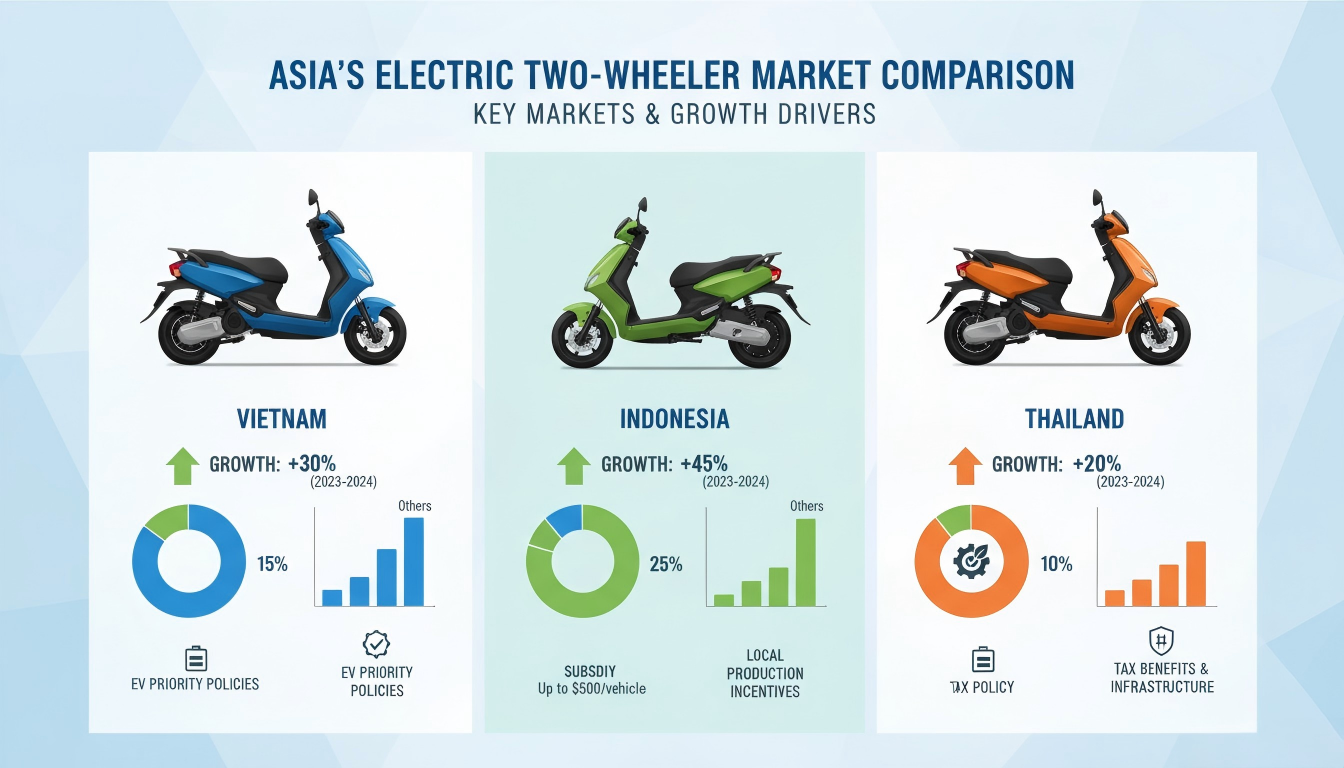
Electric motorcycle Vietnam 2026 represents one of the most dynamic markets in the region. The Vietnamese electric two-wheeler market is set for significant growth in 2026, driven by policy changes and shifting consumer behavior
.
-
Starting July 1, 2026, Hanoi will implement a low-emission zone within Ring Road 1, restricting petrol two-wheelers during specified hours
-
The low-emission zone will expand to parts of Ring Road 2 by January 2028 and Ring Road 3 by January 2030
-
Subsidies up to 3 million VND ($120) for battery conversion
-
Corporate tax breaks for manufacturers
Market Performance: VinFast, Vietnam's domestic champion, delivered a record
406,453 e-scooters in 2025—a staggering
473% increase compared to 2024
. This performance officially secured VinFast the number-one market share position in Vietnam's e-scooter segment.
The company's Evo lineup became the best-selling e-scooter range in Vietnam, with over 250,000 units delivered
. With more than 600 authorized distributors nationwide and extensive charging infrastructure, VinFast has positioned e-scooters as a preferred mobility choice among Vietnamese consumers.
2.2 Indonesia: Policy-Driven Transformation
The electric motorcycle Indonesia market is being reshaped by aggressive government incentives and the country's strategic position as the world's largest nickel producer—a critical battery material.
Government Incentives (2026):
-
Extended conversion incentives through 2025
-
Import duty reductions for EV components
-
Target: 2 million electric motorcycles by 2025
-
Mandatory local assembly for foreign brands
The emphasis on converting existing petrol motorcycles to electric powertrains provides an immediate pathway to market penetration while the government develops longer-term manufacturing policies.
2.3 Thailand: Premium Market Leadership
Thailand's Board of Investment (BOI) has established the most comprehensive incentive framework in Southeast Asia:
-
Subsidies up to 75,000 THB ($2,100) per vehicle
-
Tax exemptions for EV components
-
Target: 300,000 EVs by 2030
-
Minimum 50% local parts content requirement by 2028
This dual approach creates both opportunities for foreign manufacturers willing to establish local operations and challenges for those seeking to export finished vehicles without local investment.
3. The Competitive Landscape: Brands Battling for Market Share
3.1 VinFast's Regional Expansion
VinFast has unveiled its international business strategy for electric scooters, identifying five initial key markets:
the Philippines, Indonesia, India, Thailand, and Malaysia. This marks a significant milestone in VinFast's global expansion strategy.
Product Portfolio:
-
Battery-swapping e-scooters: VinFast Flazz, VinFast Evo, VinFast Feliz II, and VinFast Viper
-
Three distinct e-scooter lines: mainstream, premium, and sport
-
Seven new models launched in premium and sport categories for 2026
Commercial Footprint Target:
-
Hundreds of retail outlets across five key markets by 2027
-
Integrated dealer networks, service workshops, and financial solutions
-
Collaboration with V-Green for charging and battery-swapping systems
3.2 Chinese Brands' Export Strategy
Chinese manufacturers like
Yadea and AIMA continue to dominate the
electric motorcycle export strategy landscape. Chinese brands have gained significant market share in Vietnam, with Yadea achieving
61.6% growth.
Competitive Advantages:
-
Cost-effective manufacturing
-
Established supply chains
-
Diverse product portfolios
-
Aggressive pricing strategies
3.3 Traditional OEMs Enter the Fray
Honda's Strategic Response:
Honda has announced the launch of its new electric two-wheeler, the Honda UC3, in Vietnam and Thailand starting spring 2026
. Key features include:
-
Fixed-type lithium-ion phosphate battery
-
"CHAdeMO for two-wheelers" charging standard
-
Two charger options: 1200W and 450W
-
Production began December 2025 at Thai Honda Co., Ltd.
Charging Infrastructure Expansion:
4. Technology Trends: Powering the Electric Revolution
4.1 Battery Technology Evolution
Lithium-Ion Dominance: Lithium-ion batteries held approximately
79.3% of the electric scooters segment in 2024
, underscoring the market's trend toward high-performance battery systems.
Key Advancements:
-
Energy density improvements
-
Faster charging capabilities
-
Extended battery lifecycles
-
Cost reductions through scale
4.2 Battery Swapping: The Game Changer
Electric motorcycle battery swapping is emerging as a critical solution to range anxiety and charging infrastructure challenges. The market exhibits geographically concentrated clusters in densely populated Asian regions like China and Southeast Asia
.
Advantages:
-
Time efficiency: Under 60 seconds for battery exchange vs. 30+ minutes for charging
-
Cost reduction: Lower upfront vehicle costs through battery leasing models
-
Infrastructure flexibility: Smaller footprint than charging stations
-
Fleet optimization: Ideal for delivery and ride-sharing services
Key Players:
4.3 Smart Charging Solutions
For urban commuters,
IoT-enabled smart chargers allow users to charge overnight at home using off-peak electricity rates, often costing only a fraction of a tank of gasoline
.
5. Infrastructure Development: Building the Ecosystem
5.1 Charging Network Expansion
Electric two-wheeler charging pile deployment is accelerating across Asia:
| Country |
Charging Stations (2026) |
Key Initiatives |
| Vietnam |
Expanding rapidly |
Honda, VinFast deploying at dealerships |
| Thailand |
Growing network |
Government grants for infrastructure development |
| Indonesia |
Early stage |
Focus on battery swapping due to grid challenges |
| Malaysia |
15,000 target by 2025 |
Tax exemptions for infrastructure investment |
5.2 The Infrastructure Gap
Despite progress, challenges remain:
6. Electric vs Petrol: The Total Cost of Ownership Battle
6.1 The Economics of Electrification
The electric scooter vs petrol scooter comparison increasingly favors electric options when total cost of ownership is considered:
5-Year Ownership Cost Comparison (India Example):
| Cost Component |
Petrol Scooter |
Electric Scooter |
Savings |
| Initial Purchase |
₹95,000 |
₹1,20,000 |
-₹25,000 |
| Fuel/Electricity (5 years) |
₹1,35,000 |
₹19,000 |
₹1,16,000 |
| Maintenance (5 years) |
₹30,000 |
₹10,000 |
₹20,000 |
| Total 5-Year Cost |
₹2,75,500 |
₹2,04,200 |
₹71,300 |
6.2 Running Cost Analysis
Cost Per Kilometer:
Monthly Running Cost (1,000 km):
This 8-10x cost advantage in running expenses is driving consumer adoption, particularly among high-mileage commuters and fleet operators.
7. Niche Markets: The Electric Dirt Bike Revolution
While the mainstream electric motorcycle segment becomes increasingly competitive—with a supply-demand ratio of just 0.65 indicating oversupply—smart Southeast Asian manufacturers are pivoting to high-growth niche segments.
Electric dirt bikes emerge as the standout blue ocean opportunity, boasting:
Key Drivers:
-
Post-pandemic outdoor recreation boom
-
Electric advantages: instant torque, silent operation, simplified maintenance
-
Younger demographics naturally drawn to electric alternatives
8. Government Policies: The Regulatory Tailwind
8.1 Southeast Asian Incentive Comparison
| Country |
Key Incentives |
Target Timeline |
Local Production Requirements |
| Thailand |
Up to $2,100 subsidy; tax exemptions |
300,000 EVs by 2030 |
50% local content by 2028 |
| Vietnam |
$120 battery conversion subsidy |
50% electric by 2030 |
Preferential treatment for domestic brands |
| Indonesia |
Extended conversion incentives |
2 million by 2025 |
Mandatory local assembly |
| Malaysia |
Tax exemptions; infrastructure grants |
15,000 charging stations by 2025 |
Joint venture incentives |
8.2 Policy Impact Assessment
Government interventions are reshaping market dynamics:
-
Price competitiveness: Subsidies narrow the electric-petrol price gap to under 20%
-
Consumer acceptance: Growing awareness of electric advantages
-
Supply chain migration: Battery and component manufacturing shifting to Southeast Asia
9. Future Outlook: 2026-2030 Projections

9.1 Market Forecasts
-
2026 Asia electric two-wheeler sales: ~25 million units
-
2030 projection: 60+ million units
-
Electrification penetration: From 15% (2025) to 40% (2030)
9.2 Technology Roadmap
-
Solid-state batteries: Commercial applications expected by 2027-2028
-
Hydrogen fuel cells: Pilot programs for heavy-duty electric motorcycles
-
V2G integration: Vehicle-to-grid technology for energy ecosystem participation
-
Autonomous features: Limited self-driving capabilities in controlled environments
9.3 Competitive Evolution
-
Chinese brands: Expected to maintain 55-60% market share (down from 65%)
-
Local brands: Rising from 15% to 25% market share
-
International brands: Growing from 20% to 30% market share
10. Key Takeaways: The Road Ahead
The 2026 Asian electric motorcycle news paints a picture of an industry at an inflection point. Several key themes emerge:
-
Policy-driven transformation: Government incentives are the primary catalyst for adoption
-
Infrastructure evolution: Battery swapping and smart charging are solving range anxiety
-
Local champions rising: VinFast's success demonstrates the potential for regional players
-
Chinese dominance: Export strategies from Yadea, AIMA, and others continue to shape the market
-
Total cost advantage: Electric options increasingly win on economics, not just environmental benefits
-
Niche opportunities: Electric dirt bikes and commercial fleets represent high-growth segments
For industry participants, the message is clear: electric motorcycle Asia 2026 is not a future possibility—it's the present reality. Companies that adapt their strategies to this electrified landscape will thrive; those that don't risk obsolescence.
As VinFast CEO Hoang Ha stated:
"2025 marks a pivotal year in Vietnam's green mobility transition... I am confident that 2026 will be an even more remarkable year for the future of green mobility."The electric revolution on two wheels has arrived in Asia—and it's accelerating.
Frequently Asked Questions
Q: What is the market size of electric motorcycles in Asia for 2026? A: The electric motorcycle Asia 2026 market represents approximately 75% of global volume, with the Asia-Pacific region valued at USD 40.98 billion in 2026
.
Q: Which countries are leading electric motorcycle adoption in Southeast Asia? A: Vietnam leads with VinFast's 406,453 units sold in 2025, followed by Thailand with comprehensive government subsidies, and Indonesia with aggressive conversion incentives.
Q: How does battery swapping work for electric motorcycles? A: Battery swapping allows riders to exchange a depleted battery for a fully charged one in under 60 seconds, eliminating charging wait times and reducing upfront vehicle costs.
Q: Are electric motorcycles cheaper than petrol motorcycles in the long run? A: Yes. Despite higher upfront costs, electric scooters save approximately ₹71,300 ($850) over 5 years compared to petrol scooters due to lower running and maintenance costs
.
Q: What government incentives are available for electric motorcycles in Asia? A: Incentives include subsidies up to $2,100 (Thailand), tax exemptions, registration fee waivers, and dedicated EV lanes. Policies vary by country but are generally favorable.


